I was born and raised in Hungary, from a family that is itself a mix of German, Hungarian, and Slavic backgrounds — and, further back, a great-great-grandmother from Greece, which is about as close as my own family tree gets to the Middle East. No, I am not Armenian. My family name itself has Slavic roots — it likely contains "mesto" (place, town) — though its exact meaning beyond that is something of a family mystery; the first Mestyans appear in the historical record in the middle of the eighteenth century, in post-Ottoman South Hungary.
Arabic, then, is not a family inheritance but a language I chose and learned; today I work in Arabic, Ottoman Turkish, French, German, and, of course, Hungarian — and I'm currently learning Russian with great enthusiasm. When I was a student, I briefly flirted with learning modern Hebrew, Persian, Latin, and Greek. Perhaps that habit of sitting between languages and traditions is what eventually drew me to the history of empires.
My research focuses on modern Syria and Egypt, especially the political and cultural history of the late Ottoman and interwar periods. I spend several months every year in the region itself — in Egypt, Lebanon, Turkey, and, more recently, Syria. I enjoy studying the strange, the hybrid, and the forgotten in these Muslim-majority societies.
I'm also drawn to the digital humanities side of the field — building tools for working with Arabic and Ottoman sources at scale. That's led to projects like a digital textual database on nineteenth-century Cairo's urban history and a chronology of Arabic periodicals, 1800–1929. I co-curate the TEI Arabic Scripts Forum.
Before becoming a full-time academic, I was the bass guitarist of the Hungarian underground band the Galloping Coroners (VHK, Vágtázó Halottkémek) between 1996 and 2014, and established a number of other Hungarian bands, including Yava Folcore Punk Brigade and the hardcore group Dereng.
I have also published two award-winning books of poems in Hungarian in the 2000s — The Rules of Hungarian Orthography (2006) and The Perfect Absence of Compassion (2010).
Between 1999 and 2009 I wrote critiques of contemporary dance, ballet, theater, and fine art for Hungarian art journals.
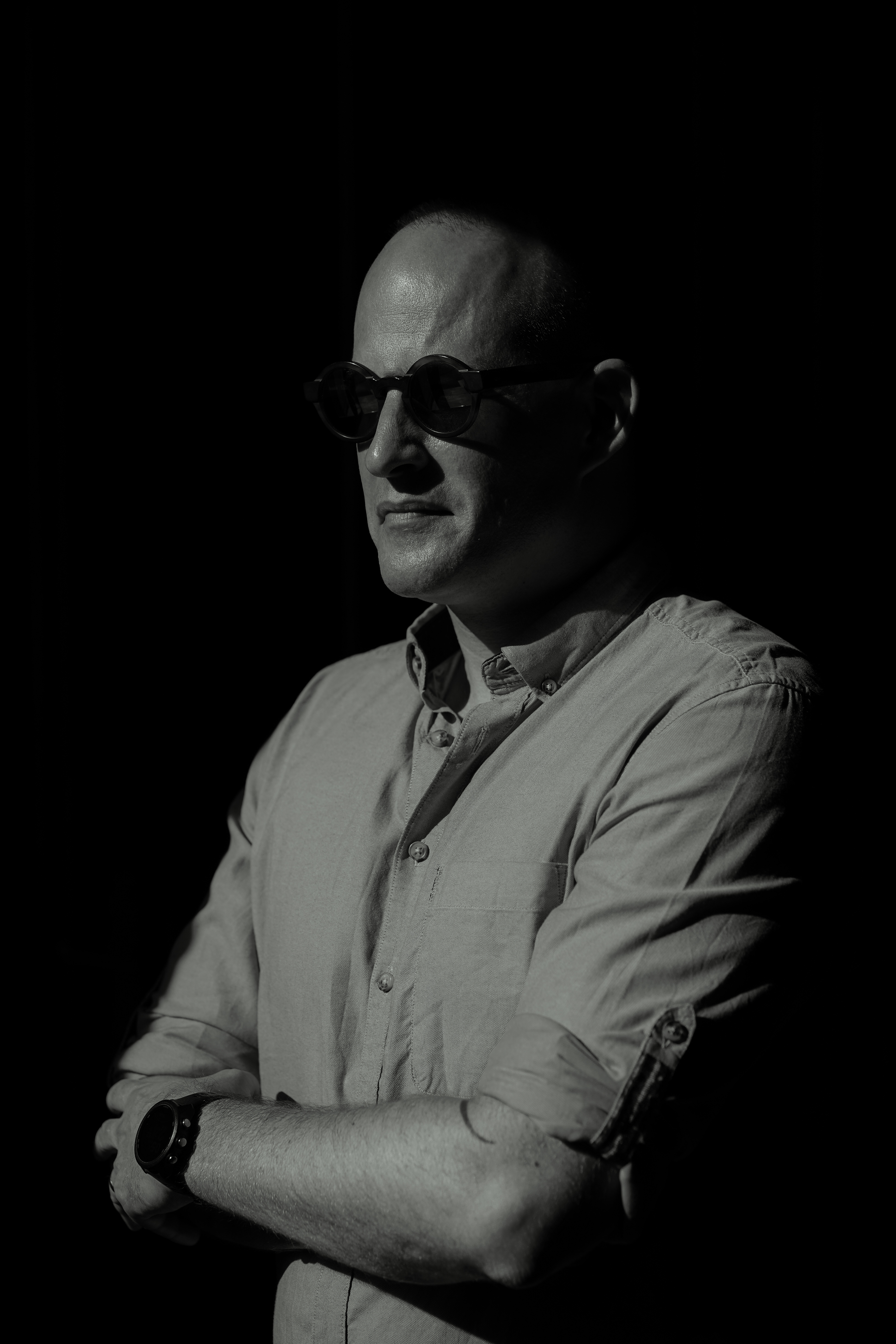
(Photo by Metwally Ryad, Cairo, 2025)